
Library

The Library

Everything we have published, gathered like chapters in a book. Each chapter opens with its card, then gives our words exactly as we posted them, then the sources, so you can check it yourself.

New chapters are added as we publish them.

If you are in immediate danger, call 911. Domestic violence support: 1-800-799-7233.

Our Notices

Notice · October 5, 2026

Notice to the Nation
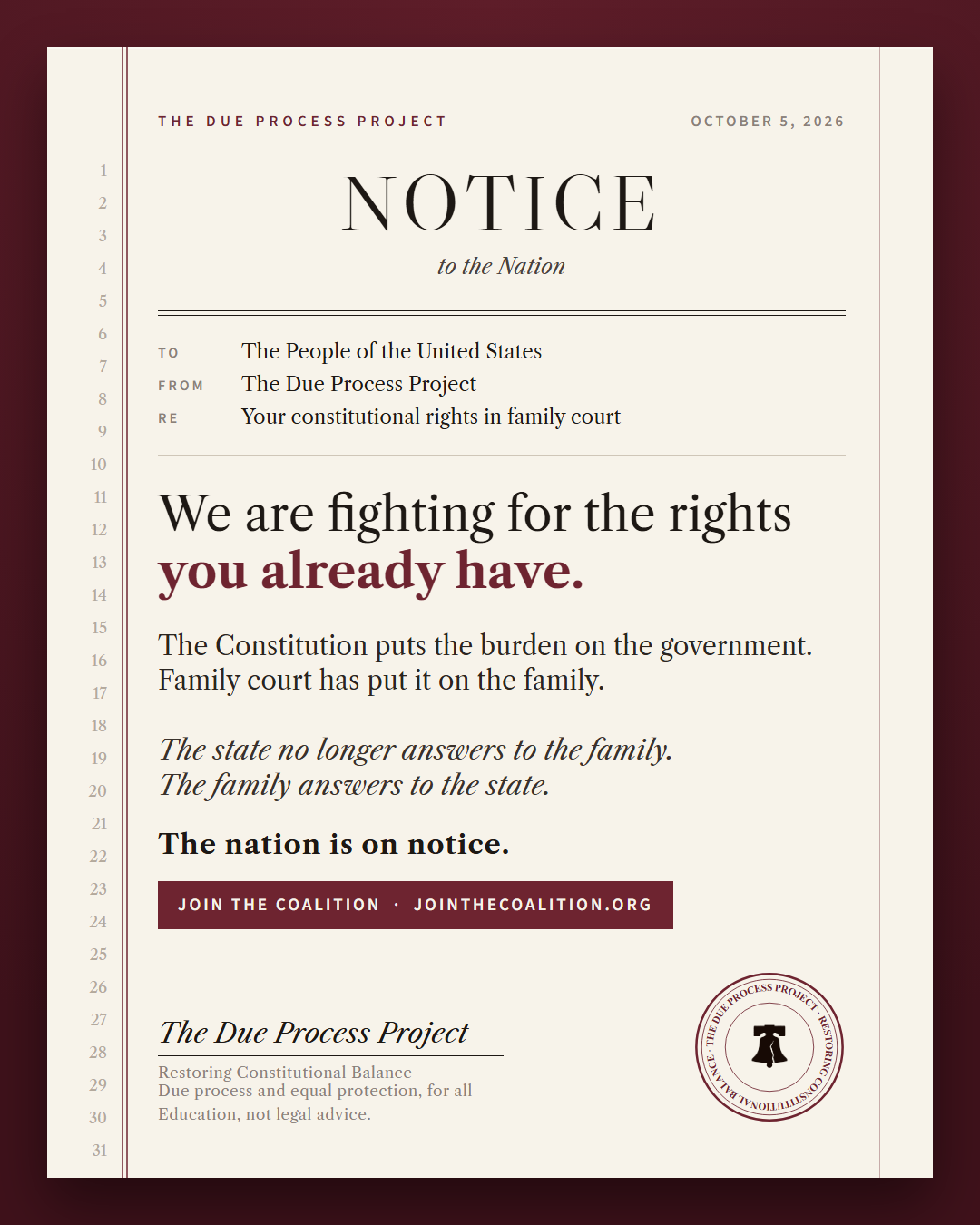
Pleading-paper card from The Due Process Project titled NOTICE to the Nation, dated October 5, 2026. To: The People of the United States. From: The Due Process Project. Re: Your constitutional rights in family court. We are fighting for the rights you already have. The Constitution puts the burden on the government. Family court has put it on the family. The state no longer answers to the family. The family answers to the state. The nation is on notice. Join the coalition: jointhecoalition.org. Restoring Constitutional Balance. Due process and equal protection, for all. Education, not legal advice.
The card as posted. Tap it to open full size. © 2026 The Due Process Project.

NOTICE TO THE NATION.

Due process begins with notice. This is ours.

To every parent told to prove they deserve their own child. To every child who lost a parent to a process no one could explain. To every family who walked into court believing the Constitution walked in with them.

Hear this.

In America, the government answers to the people. The government carries the burden. The government proves its case before it takes your liberty. You do not earn your liberty back.

That is the promise. In family court, it has been broken.

Hear this.

We are fighting for the rights you already have.

The right to raise your children. The right to notice and a fair hearing before your liberty is taken. The right to the same rules as every other family.

These are not favors from the state. They are guarantees of the United States Constitution, binding on every state.

Too many families subject to family court never knew they had these rights until they were already gone.

Few places in American law restrict liberty as freely as family court. It decides who raises the children. It cuts a parent's time to supervised hours, or to nothing. It can put a parent in jail. And too often it does so on the lowest standard of proof the law allows, or with none named at all.

One court finds the facts. The same court chooses the professionals and sets what families pay them. The same court restricts the parent. The same court enforces with jail. The same court system writes many of its own rules and largely polices itself.

The Constitution puts the burden on the government. Family court has put it on the family. The state no longer answers to the family. The family answers to the state.

That concentration of power is unacceptable. It is destroying lives.

This is not mothers against fathers. It is not left against right. Every child who needs protection deserves the truth. Every parent deserves a fair hearing. A system guided by unchecked discretion fails them both.

Join us: parents, grandparents, neighbors. Attorneys, mental health professionals, researchers, journalists, advocates. Everyone who believes the Constitution still means what it says. The American promise of life, liberty, and the pursuit of happiness.

The Due Process Project stands with all citizens seeking fair and equal treatment under the law, and with the coalition organized by Stand With Meg, a growing alliance of families and professionals across the country. Join here: jointhecoalition.org

Today we stand. United. Peacefully. Lawfully. Together. We the People, our Constitution in hand.

The nation is on notice.

Share this. Let every family hear it.

Learn your rights: https://thedueprocessproject.org

Restoring Constitutional Balance. Due process and equal protection, for all. Education, not legal advice.

As posted on our Facebook Page on Monday, October 5, 2026. See the original post.

© 2026 The Due Process Project. You may share this chapter and its card unaltered, with this notice, for non-commercial use, as our Terms of Use allow. The court opinions, statutes and constitutional text it quotes are public law.
Next: Behind the Notice: The problem, plainly · Contents

Behind the Notice · Part 1 · November 27, 2026

Behind the Notice: The problem, plainly

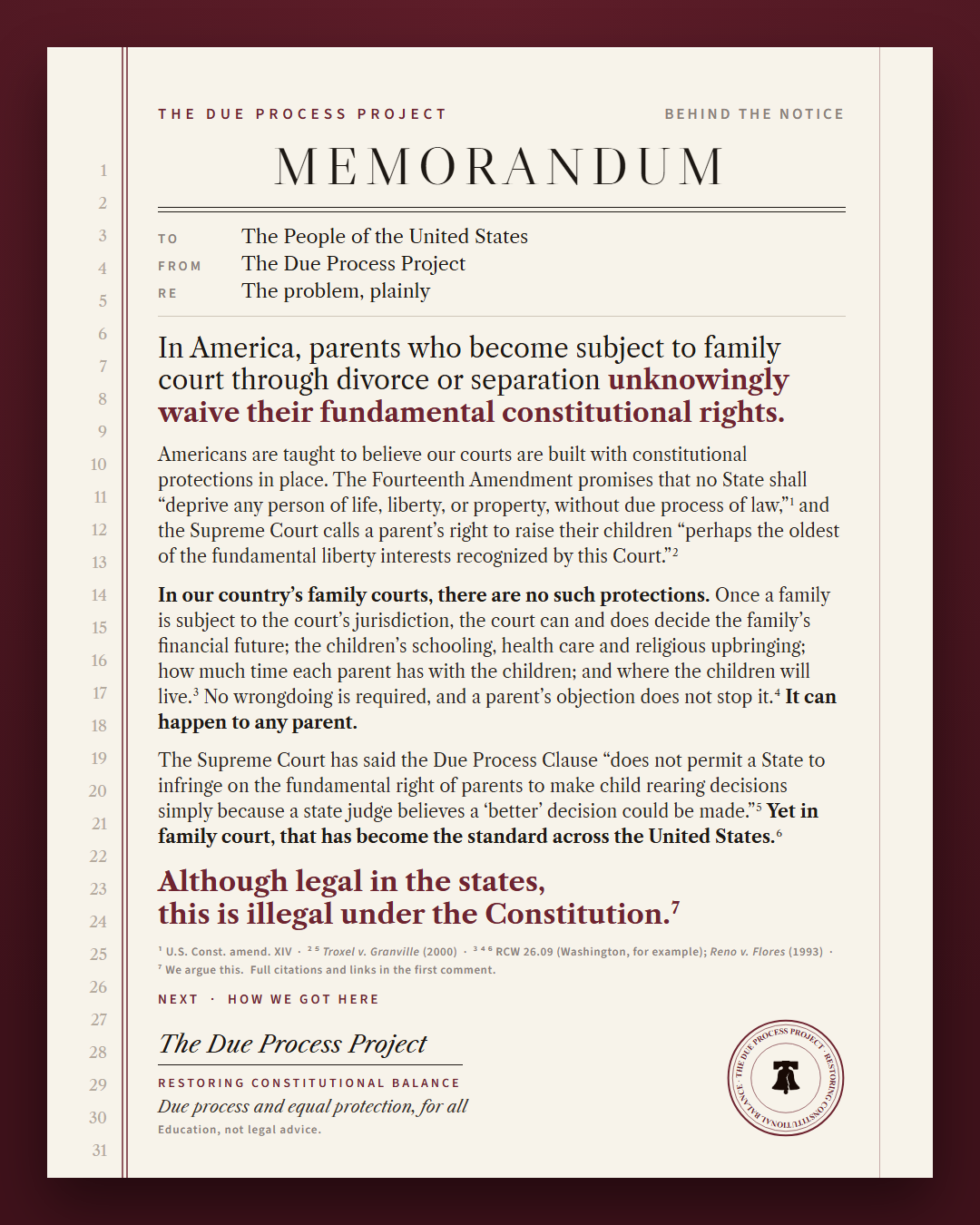
Card from The Due Process Project, set as a memorandum. Behind the Notice. To: The People of the United States. From: The Due Process Project. Re: The problem, plainly. In America, parents who become subject to family court through divorce or separation unknowingly waive their fundamental constitutional rights. Americans are taught to believe our courts are built with constitutional protections in place. The Fourteenth Amendment promises that no State shall "deprive any person of life, liberty, or property, without due process of law," and the Supreme Court calls a parent's right to raise their children "perhaps the oldest of the fundamental liberty interests recognized by this Court." In our country's family courts, there are no such protections. Once a family is subject to the court's jurisdiction, the court can and does decide the family's financial future; the children's schooling, health care and religious upbringing; how much time each parent has with the children; and where the children will live. No wrongdoing is required, and a parent's objection does not stop it. It can happen to any parent. The Supreme Court has said the Due Process Clause "does not permit a State to infringe on the fundamental right of parents to make child rearing decisions simply because a state judge believes a 'better' decision could be made." Yet in family court, that has become the standard across the United States. Although legal in the states, this is illegal under the Constitution. Next: How we got here. Restoring Constitutional Balance. Due process and equal protection, for all. Education, not legal advice.
The card as posted. Tap it to open full size. © 2026 The Due Process Project.

BEHIND THE NOTICE.
The problem, plainly.

In America, parents who become subject to family court through divorce or separation unknowingly waive their fundamental constitutional rights.

Americans are taught to believe our courts are built with constitutional protections in place. The Fourteenth Amendment promises that no State shall "deprive any person of life, liberty, or property, without due process of law,"¹ and the Supreme Court calls a parent's right to raise their children "perhaps the oldest of the fundamental liberty interests recognized by this Court."²

In our country's family courts, there are no such protections. Once a family is subject to the court's jurisdiction, the court can and does decide the family's financial future; the children's schooling, health care and religious upbringing; how much time each parent has with the children; and where the children will live.³ No wrongdoing is required, and a parent's objection does not stop it.⁴ It can happen to any parent.

The Supreme Court has said the Due Process Clause "does not permit a State to infringe on the fundamental right of parents to make child rearing decisions simply because a state judge believes a 'better' decision could be made."⁵ Yet in family court, that has become the standard across the United States.⁶

Although legal in the states, this is illegal under the Constitution.⁷

Next, Behind the Notice: How we got here.

Read the Notice to the Nation: https://www.facebook.com/thedueprocessproject/posts/122112280485483679

¹ U.S. Const. amend. XIV, § 1.
² Troxel v. Granville, 530 U.S. 57, 65 (2000) (plurality opinion).
³ Washington's law, for example: RCW 26.09.050(1), .184(5)(a), .187(2)(b), (3), .520.
⁴ Washington's law, for example: RCW 26.09.187(2)(b)(ii)-(iii), (3)(a).
⁵ Troxel, 530 U.S. at 72-73.
⁶ Washington's law, for example: RCW 26.09.002. See Troxel, 530 U.S. at 67. Nationally, see Reno v. Flores, 507 U.S. 292, 303-04 (1993).
⁷ We argue this from Meyer v. Nebraska, 262 U.S. 390, 399 (1923); Stanley v. Illinois, 405 U.S. 645, 658 (1972); Santosky v. Kramer, 455 U.S. 745, 747-48 (1982); Washington v. Glucksberg, 521 U.S. 702, 720-21 (1997); and Troxel, 530 U.S. at 65, 68-69. The Supreme Court has not yet applied these cases to a custody order between two parents.

If you are in immediate danger, call 911. Domestic violence support: 1-800-799-7233.

Restoring Constitutional Balance. Due process and equal protection, for all.
Education, not legal advice.

Check it yourself

Our first comment on the post, as posted:

Check it yourself. Each number in the post matches a source below: the Constitution from the National Archives, the Supreme Court's opinions in the official U.S. Reports, and Washington's statutes from the Legislature's own site. The case links open the official PDF; on most computers it opens at the quoted page, and some browsers download it instead.

¹ U.S. Const. amend. XIV, § 1
https://www.archives.gov/founding-docs/amendments-11-27

² Troxel v. Granville, 530 U.S. 57, 65 (2000) (plurality opinion) (PDF)
https://tile.loc.gov/storage-services/service/ll/usrep/usrep530/usrep530057/usrep530057.pdf#page=9

³ Washington's law, for example:
RCW 26.09.050(1) (support, maintenance, property and debts, and a parenting plan in every decree)
https://app.leg.wa.gov/RCW/default.aspx?cite=26.09.050
RCW 26.09.184(5)(a) (education, health care and religious upbringing)
https://app.leg.wa.gov/RCW/default.aspx?cite=26.09.184
RCW 26.09.187(2)(b), (3) (decision-making and residential time)
https://app.leg.wa.gov/RCW/default.aspx?cite=26.09.187
RCW 26.09.520 (relocation of the child)
https://app.leg.wa.gov/RCW/default.aspx?cite=26.09.520

⁴ RCW 26.09.187(2)(b)(ii)-(iii) (when the parents disagree on shared decision-making, the court gives sole decision-making to one of them); RCW 26.09.187(3)(a) (the court "shall make residential provisions for each child"; "[t]he wishes of the parents" are one factor among seven, and none of the seven requires wrongdoing)
https://app.leg.wa.gov/RCW/default.aspx?cite=26.09.187

⁵ Troxel, 530 U.S. at 72-73 (plurality opinion) (PDF)
https://tile.loc.gov/storage-services/service/ll/usrep/usrep530/usrep530057/usrep530057.pdf#page=16

⁶ RCW 26.09.002 (the best interests of the child "shall be the standard")
https://app.leg.wa.gov/RCW/default.aspx?cite=26.09.002
Troxel, 530 U.S. at 67 ("Should the judge disagree with the parent's estimation of the child's best interests, the judge's view necessarily prevails.") (PDF)
https://tile.loc.gov/storage-services/service/ll/usrep/usrep530/usrep530057/usrep530057.pdf#page=11
Reno v. Flores, 507 U.S. 292, 303-04 (1993) (calling "the best interests of the child" "a venerable phrase familiar from divorce proceedings") (PDF)
https://tile.loc.gov/storage-services/service/ll/usrep/usrep507/usrep507292/usrep507292.pdf#page=12

⁷ We argue this from the cases below. The Supreme Court has not yet applied them to a custody order between two parents. Our next post takes that up.
Meyer v. Nebraska, 262 U.S. 390, 399 (1923) (PDF)
https://tile.loc.gov/storage-services/service/ll/usrep/usrep262/usrep262390/usrep262390.pdf#page=10
Stanley v. Illinois, 405 U.S. 645, 658 (1972) (PDF)
https://tile.loc.gov/storage-services/service/ll/usrep/usrep405/usrep405645/usrep405645.pdf#page=14
Santosky v. Kramer, 455 U.S. 745, 747-48 (1982) (PDF)
https://tile.loc.gov/storage-services/service/ll/usrep/usrep455/usrep455745/usrep455745.pdf#page=3
Washington v. Glucksberg, 521 U.S. 702, 720-21 (1997) (PDF)
https://tile.loc.gov/storage-services/service/ll/usrep/usrep521/usrep521702/usrep521702.pdf#page=19
Troxel, 530 U.S. at 65, 68-69 (plurality opinion) (PDF)
https://tile.loc.gov/storage-services/service/ll/usrep/usrep530/usrep530057/usrep530057.pdf#page=9

The Court's words and the statutes' words are in quotation marks. Everything else is ours.

Education, not legal advice.

As posted on our Facebook Page on Friday, November 27, 2026. See the original post.

© 2026 The Due Process Project. You may share this chapter and its card unaltered, with this notice, for non-commercial use, as our Terms of Use allow. The court opinions, statutes and constitutional text it quotes are public law.
Next: Answer to the Notice · Contents

Answer · October 7, 2026

Answer to the Notice

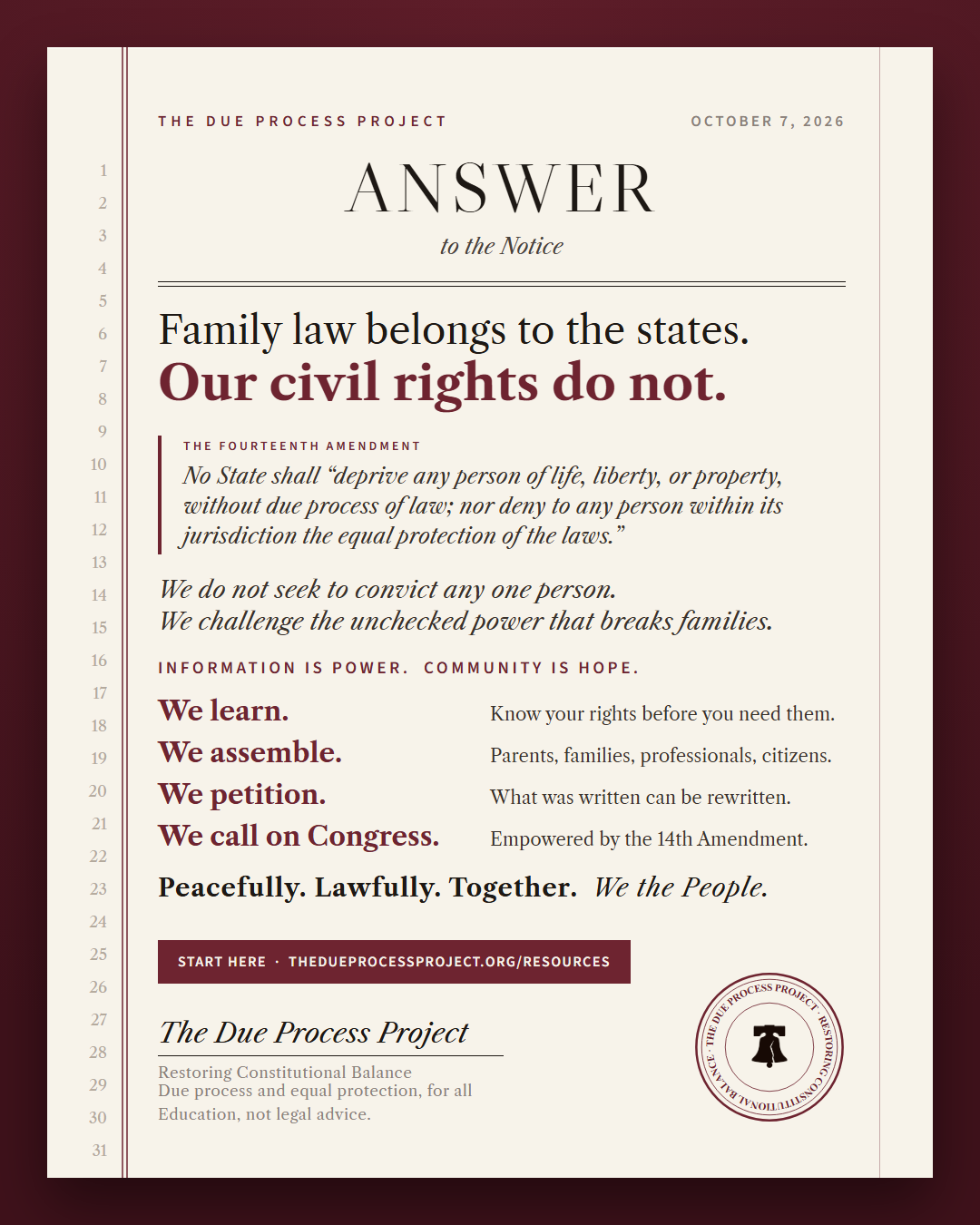
Pleading-paper card from The Due Process Project titled ANSWER to the Notice. Headline: Family law belongs to the states. Our civil rights do not. It quotes the Fourteenth Amendment: no State shall deprive any person of life, liberty, or property, without due process of law, nor deny any person the equal protection of the laws. We do not seek to convict any one person. We challenge the unchecked power that breaks families. Information is power. Community is hope. We learn. We assemble. We petition. We call on Congress. Peacefully. Lawfully. Together. We the People.
The card as posted. Tap it to open full size. © 2026 The Due Process Project.

THE NATION IS ON NOTICE. NOW WE THE PEOPLE ANSWER.

Family law belongs to the states.
Our civil rights do not.

They belong to us. Every parent. Every child. Every family, in every state.

America made that promise in the Fourteenth Amendment. No State shall "deprive any person of life, liberty, or property, without due process of law; nor deny to any person within its jurisdiction the equal protection of the laws."

No State. Not its agencies. Not its courts.

Too many families have been told that promise does not reach them.

Hear this. It does.

We do not seek to convict any one person. We challenge the unchecked power that breaks families.

The power to change it has been ours all along. The Constitution opens with three words for a reason: We the People.

Information is power. Community is hope.

So we do what free people have always done.

We learn. Know your rights before you need them. Our Family Court Playbooks are free.

We assemble. Parents, families, professionals, citizens. Join the coalition.

We petition. Every law that allowed this was written by lawmakers. Every one can be rewritten. The hearings are public. Your legislator works for you.

We call on Congress. The Fourteenth Amendment gives Congress the power to enforce it. Congress will hear from us.

Peacefully. Lawfully. Together.
We the People, our Constitution in hand.

This is our answer. It begins.

Share this. Let every family hear it.

Free Family Court Playbooks: thedueprocessproject.org/resources
Join the coalition: https://jointhecoalition.org

If you are in immediate danger, call 911. Domestic violence support: 1-800-799-7233.
Restoring Constitutional Balance. Due process and equal protection, for all.
Education, not legal advice.

As posted on our Facebook Page on Wednesday, October 7, 2026. See the original post.

© 2026 The Due Process Project. You may share this chapter and its card unaltered, with this notice, for non-commercial use, as our Terms of Use allow. The court opinions, statutes and constitutional text it quotes are public law.
Next: Part 1: What already belongs to you · Contents

We Learn

We Learn · Part 1 · October 12, 2026

Part 1: What already belongs to you

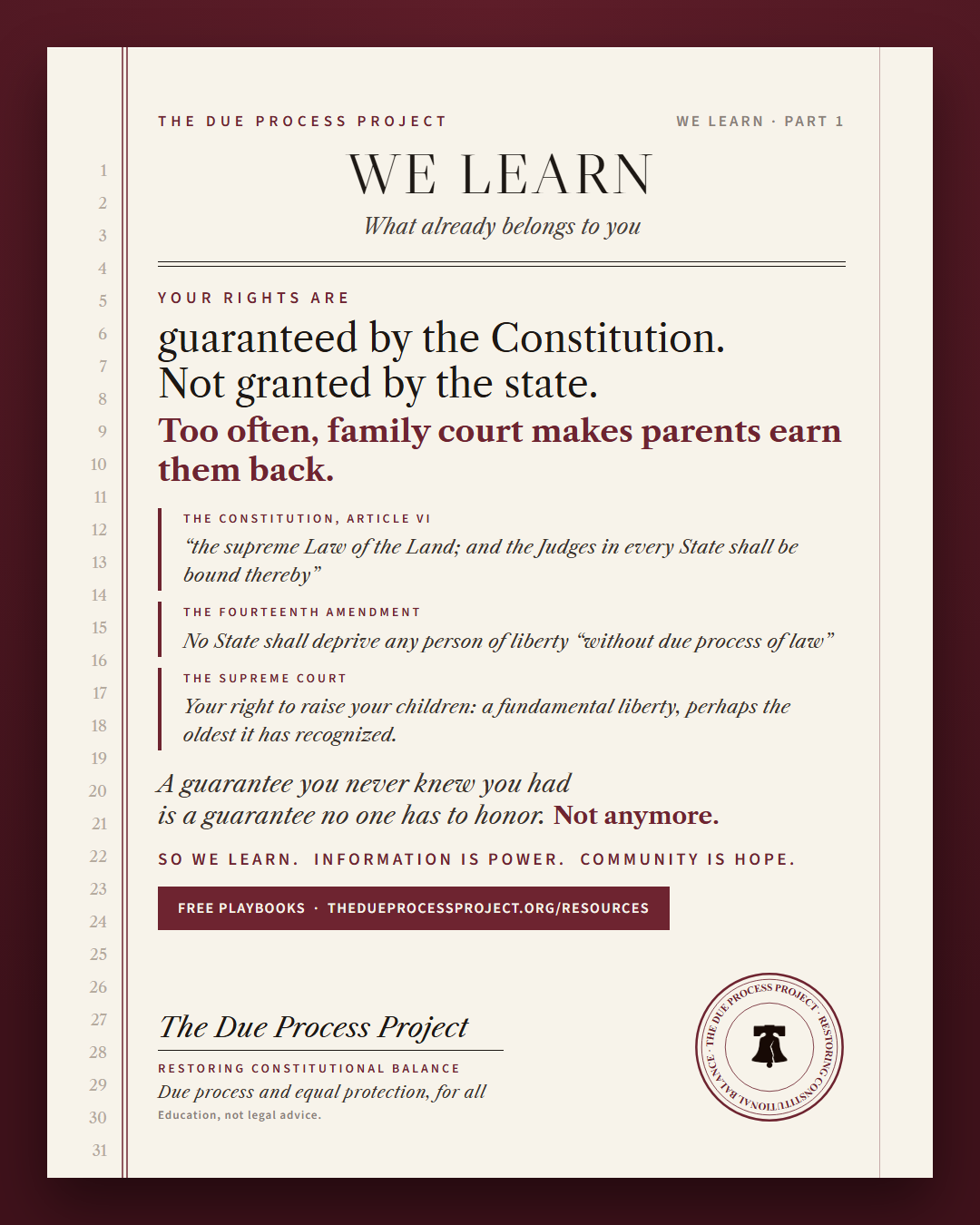
Pleading-paper card from The Due Process Project titled WE LEARN, What already belongs to you. Your rights are guaranteed by the Constitution, not granted by the state. Too often, family court makes parents earn them back. Quotes Article VI: the supreme Law of the Land, and the Judges in every State shall be bound thereby. The Fourteenth Amendment: no State shall deprive any person of liberty without due process of law. The Supreme Court: your right to raise your children is a fundamental liberty, perhaps the oldest it has recognized. A guarantee you never knew you had is a guarantee no one has to honor. Not anymore. So we learn. Information is power. Community is hope.
The card as posted. Tap it to open full size. © 2026 The Due Process Project.

WE LEARN.
Part 1: What already belongs to you.

Your rights are guaranteed by the United States Constitution.
They are not a grant from the state.
Yet too often, family court makes parents earn back rights they never knew they had.

We are going to change that.

Hear this.

The Constitution is "the supreme Law of the Land." It affirms that "the Judges in every State shall be bound thereby." And it requires every state judicial officer to be "bound by Oath or Affirmation, to support this Constitution."

The Fourteenth Amendment says no State shall "deprive any person of life, liberty, or property, without due process of law."

What belongs to you:

The right to raise your children, a fundamental liberty, perhaps the oldest the Supreme Court has recognized.

Your liberty, your property, and the privacy of your home.

Family court can reach every one of them.

What protects them:

Due process: the state must have a compelling reason before it limits a fundamental right, and must give you notice and a real chance to be heard.

Equal protection: the same rules as every other family.

That is not a favor from the state. It is a guarantee.

But a guarantee you never knew you had is a guarantee no one has to honor.

Not anymore.

Knowing your rights is not about confrontation. It is about clarity.

So we learn. Information is power. Community is hope.

Next: what due process actually requires.

Start with Playbook 4, "Family Court and Your Rights": thedueprocessproject.org/resources
Join the coalition: https://jointhecoalition.org

If you are in immediate danger, call 911. Domestic violence support: 1-800-799-7233.
Restoring Constitutional Balance. Due process and equal protection, for all.
Education, not legal advice.

As posted on our Facebook Page on Monday, October 12, 2026. See the original post.

© 2026 The Due Process Project. You may share this chapter and its card unaltered, with this notice, for non-commercial use, as our Terms of Use allow. The court opinions, statutes and constitutional text it quotes are public law.
Next: Part 2: What due process actually requires · Contents

We Learn · Part 2 · October 20, 2026

Part 2: What due process actually requires

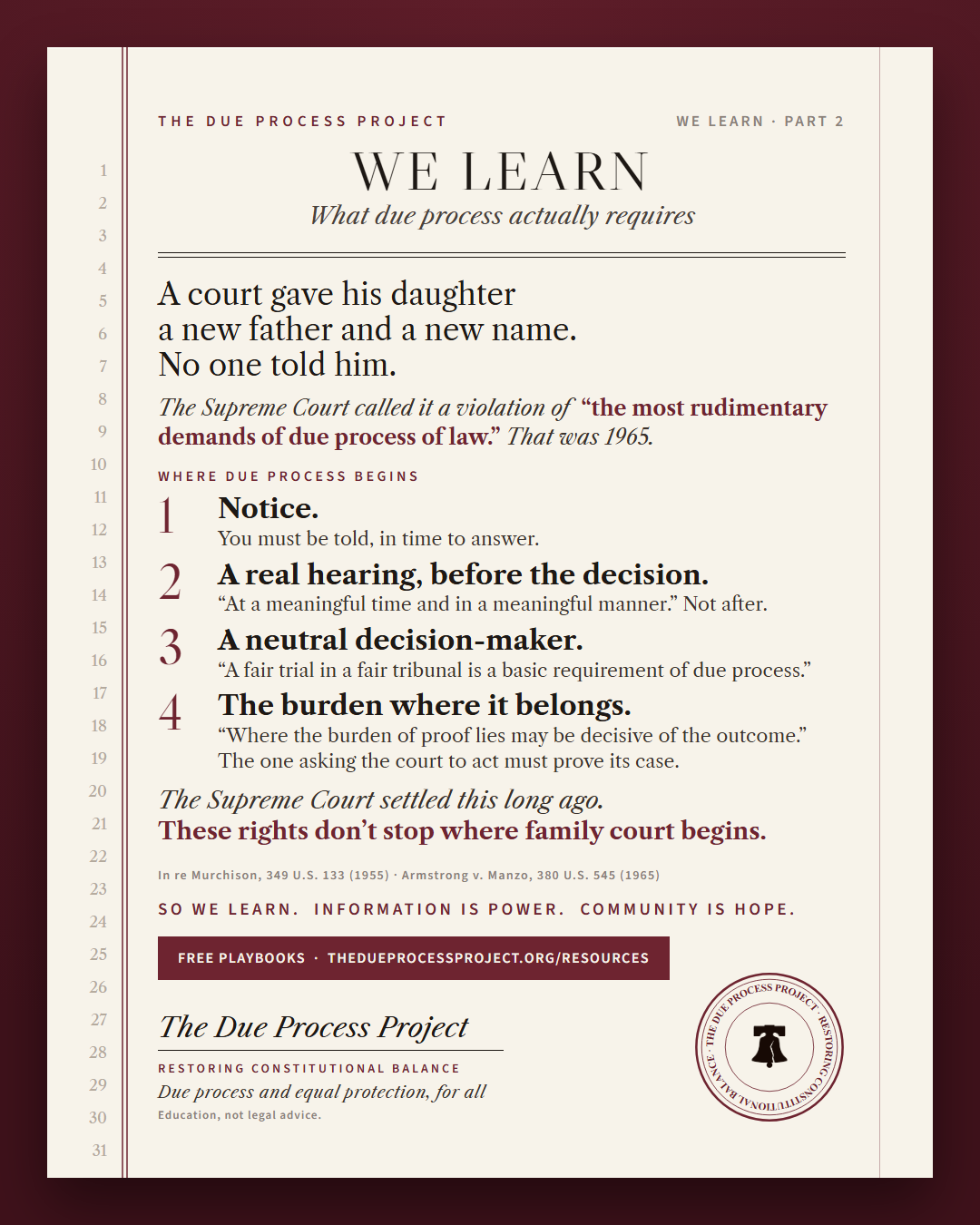
Card from The Due Process Project titled "We Learn: What due process actually requires." A court gave his daughter a new father and a new name, and no one told him. In 1965 the Supreme Court called it a violation of the most rudimentary demands of due process of law. Where due process begins: 1. Notice. 2. A real hearing, before the decision. 3. A neutral decision-maker. 4. The burden where it belongs. These rights don't stop where family court begins.
The card as posted. Tap it to open full size. © 2026 The Due Process Project.

WE LEARN.
Part 2: What due process actually requires.

A court gave his daughter a new father and a new name.
No one told him.

When he found out and went to court, he was the one made to prove himself.

The Supreme Court of the United States said the failure to tell him violated "the most rudimentary demands of due process of law." The burden belonged on the other side, it said, and only a fresh start "would have wiped the slate clean."

That was 1965.

Hear this. Today, in too many family courts, parents are still the ones made to prove themselves.

Know where due process begins.

Notice. You must be told, in time to answer.

A real hearing, before the decision. "At a meaningful time and in a meaningful manner." Not after.

A neutral decision-maker. "A fair trial in a fair tribunal is a basic requirement of due process." No one may judge a case they have a stake in.

The burden where it belongs. "Where the burden of proof lies may be decisive of the outcome." The one asking the court to act must prove its case. A parent should never have to prove their way back.

The Supreme Court settled this long ago. These rights don't stop where family court begins.

Information is power. Community is hope.

Next: the fit-parent presumption.

Start with Playbook 4, "Family Court and Your Rights": https://thedueprocessproject.org/resources
Join the coalition: https://jointhecoalition.org

If you are in immediate danger, call 911. Domestic violence support: 1-800-799-7233.
Restoring Constitutional Balance. Due process and equal protection, for all.
Education, not legal advice.

As posted on our Facebook Page on Tuesday, October 20, 2026. See the original post.

© 2026 The Due Process Project. You may share this chapter and its card unaltered, with this notice, for non-commercial use, as our Terms of Use allow. The court opinions, statutes and constitutional text it quotes are public law.
Next: Part 3: You walk in a fit parent · Contents

We Learn · Part 3 · October 27, 2026

Part 3: You walk in a fit parent

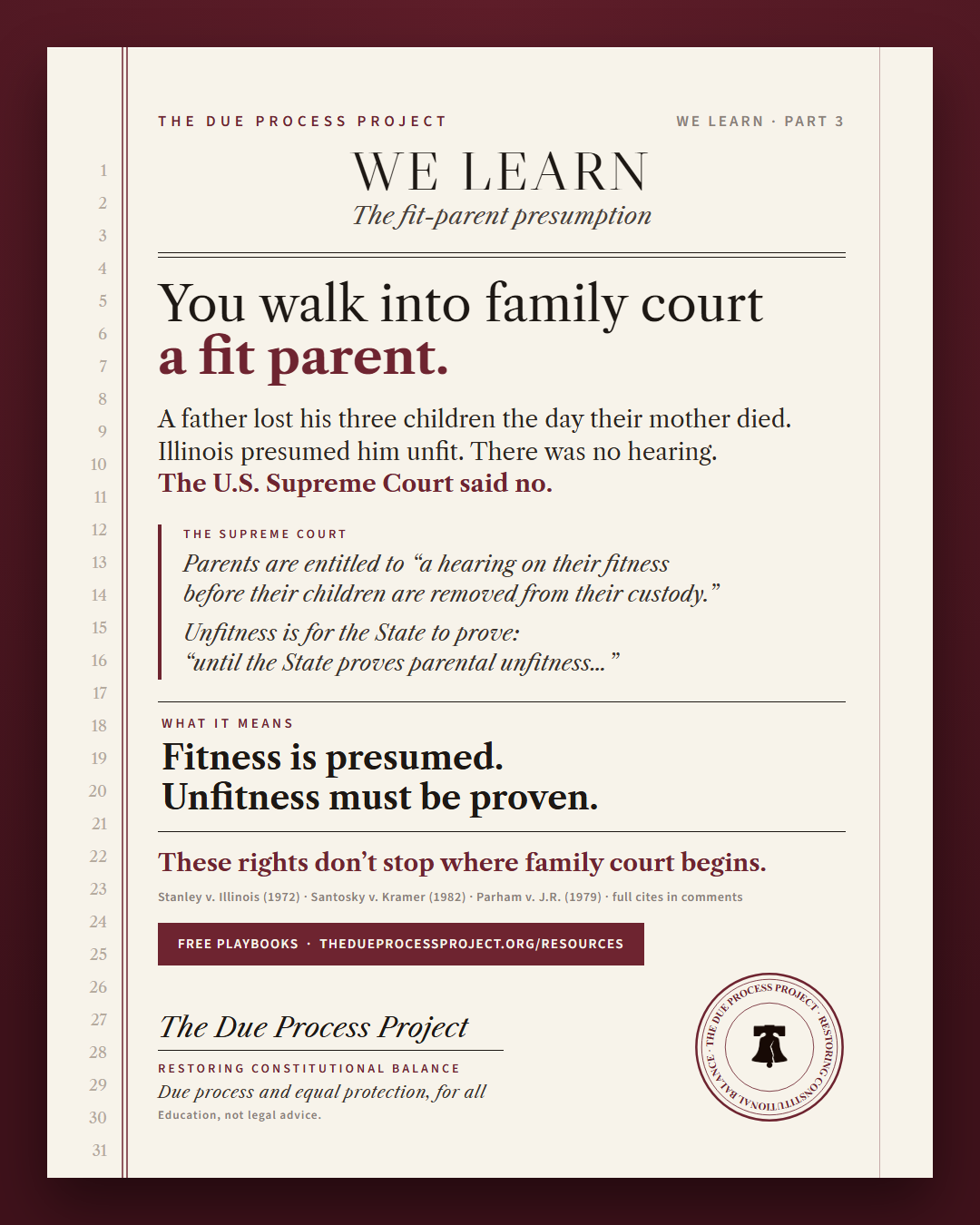
Card from The Due Process Project titled "We Learn: The fit-parent presumption." Headline: You walk into family court a fit parent. A father lost his three children the day their mother died; Illinois presumed him unfit, with no hearing; the U.S. Supreme Court said no. The Supreme Court: parents are entitled to "a hearing on their fitness before their children are removed from their custody," and unfitness is for the State to prove. What it means: Fitness is presumed. Unfitness must be proven. These rights don't stop where family court begins.
The card as posted. Tap it to open full size. © 2026 The Due Process Project.

WE LEARN.
Part 3: You walk in a fit parent.

A mother and father lived together, on and off, for 18 years. They had three children.
When she died, he lost her. Then he lost his children.
The law presumed he was unfit. No one ever held a hearing to ask.¹

The Supreme Court of the United States said no.

Hear this.

The law starts with the parent. "The law's concept of the family rests on a presumption that parents possess what a child lacks in maturity, experience, and capacity for judgment required for making life's difficult decisions."²

Know what the presumption means.

You walk in a fit parent. The Court held that parents are "constitutionally entitled to a hearing on their fitness before their children are removed from their custody."¹

Unfitness must be proven. In the Court's words: "until the State proves parental unfitness, the child and his parents share a vital interest in preventing erroneous termination of their natural relationship."³

No one may presume you unfit. Not by category. Not by assumption. Not by shortcut.

We argue: any state law that makes a parent prove their way back to fitness has the Constitution backwards.

This presumption belongs to every parent. It doesn't stop where family court begins.

Connect the dots.
The law presumes the parent, not the State, acts in the child's best interests. As the Court put it: "natural bonds of affection lead parents to act in the best interests of their children."²
Last week: "Where the burden of proof lies may be decisive of the outcome."⁴
So when a court limits a parent, who should have to prove it?

Information is power. Community is hope.

Share this. Let every family hear it.

Next: the law trusts a fit parent's judgment.

Start with Playbook 4, "Family Court and Your Rights": https://thedueprocessproject.org/resources
Join the coalition: https://jointhecoalition.org

If you are in immediate danger, call 911. Domestic violence support: 1-800-799-7233.
Restoring Constitutional Balance. Due process and equal protection, for all.
Education, not legal advice.

Check it yourself

Our first comment on the post, as posted:

Check it yourself. Each number in the post matches a source below: the Supreme Court's own opinions, in the official U.S. Reports. On most computers, each link opens at the quoted page.

¹ Stanley v. Illinois, 405 U.S. 645, 646, 658 (1972)
https://tile.loc.gov/storage-services/service/ll/usrep/usrep405/usrep405645/usrep405645.pdf#page=14

² Parham v. J.R., 442 U.S. 584, 602 (1979)
https://tile.loc.gov/storage-services/service/ll/usrep/usrep442/usrep442584/usrep442584.pdf#page=19

³ Santosky v. Kramer, 455 U.S. 745, 760 (1982)
https://tile.loc.gov/storage-services/service/ll/usrep/usrep455/usrep455745/usrep455745.pdf#page=16

⁴ Speiser v. Randall, 357 U.S. 513, 525 (1958)
https://tile.loc.gov/storage-services/service/ll/usrep/usrep357/usrep357513/usrep357513.pdf#page=13

Education, not legal advice.

As posted on our Facebook Page on Tuesday, October 27, 2026. See the original post.

© 2026 The Due Process Project. You may share this chapter and its card unaltered, with this notice, for non-commercial use, as our Terms of Use allow. The court opinions, statutes and constitutional text it quotes are public law.
Next: Part 4: The law trusts a fit parent's judgment · Contents

We Learn · Part 4 · November 10, 2026

Part 4: The law trusts a fit parent's judgment

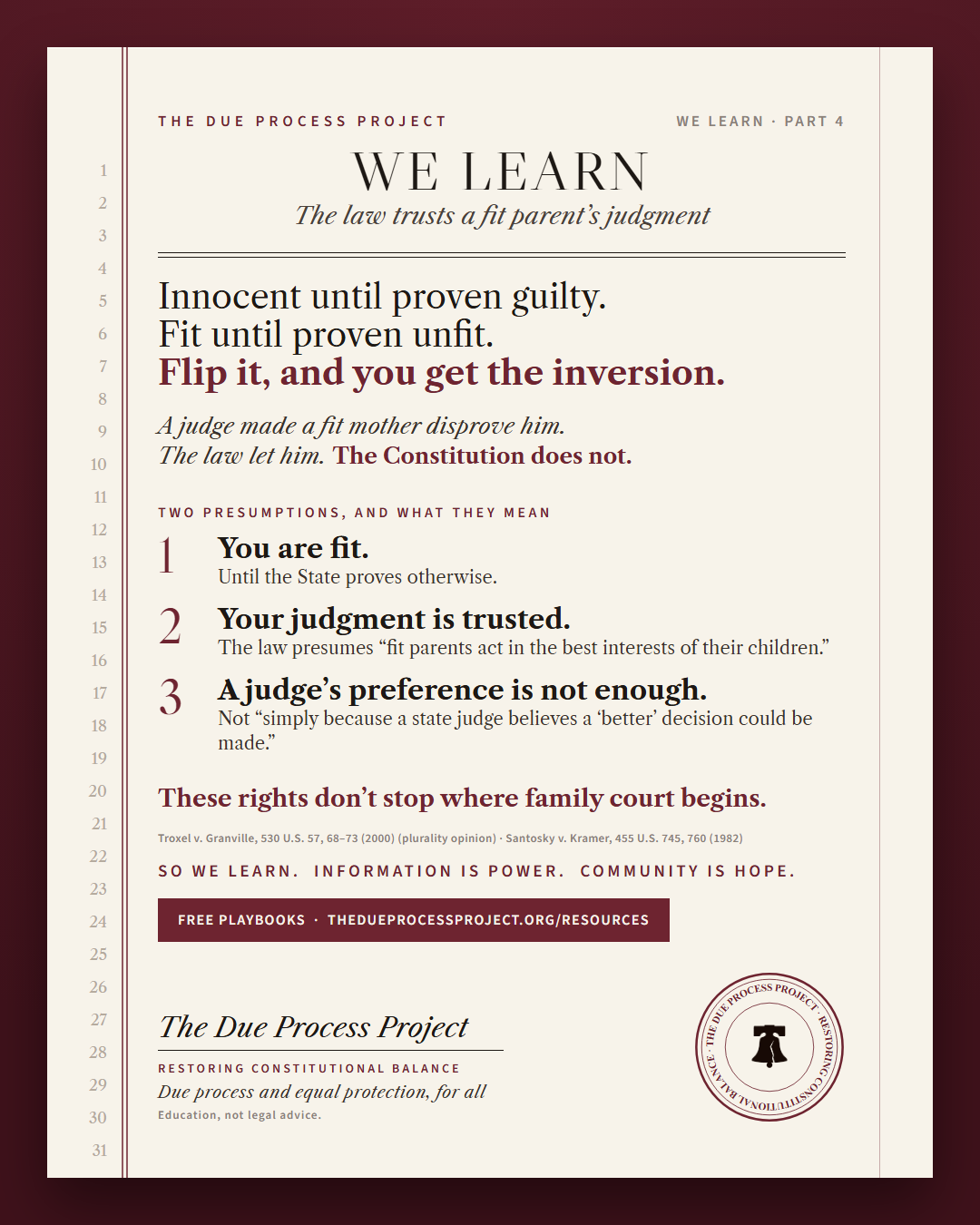
Card from The Due Process Project, We Learn Part 4: The law trusts a fit parent's judgment. Innocent until proven guilty. Fit until proven unfit. Flip it, and you get the inversion. A judge made a fit mother disprove him. The law let him. The Constitution does not. Two presumptions, and what they mean: 1. You are fit, until the State proves otherwise. 2. Your judgment is trusted. The law presumes fit parents act in the best interests of their children. 3. A judge's preference is not enough. Not simply because a state judge believes a better decision could be made. These rights don't stop where family court begins. Sources: Troxel v. Granville, 530 U.S. 57 (2000) (plurality opinion); Santosky v. Kramer, 455 U.S. 745 (1982). Education, not legal advice.
The card as posted. Tap it to open full size. © 2026 The Due Process Project.

WE LEARN.
Part 4: The law trusts a fit parent's judgment.

Imagine a judge overruling a decision you made for your own children.
Not because anyone proved you unfit.
Because he would have done it differently.
Then making you prove him wrong.

That happened. And the Supreme Court of the United States said no.

The foundation.

You already know this principle: innocent until proven guilty. You never have to prove your innocence. The government has to prove its case.

The Constitution starts every parent in the same place. Two presumptions:

1. You are fit. Until the State proves otherwise, the law treats you as a fit parent.²
2. You know what is best for your own children. "[T]here is a presumption that fit parents act in the best interests of their children."¹

Put them together, and they mean one thing: a fit parent's judgment comes first. A court must give it "at least some special weight."¹ If the State wants to override it, the State carries the burden.

The case.

A fit mother in Washington. No court ever found otherwise. She wanted her daughters to keep seeing their late father's parents: a visit every month, plus holidays. A judge ordered more. His reason for part of that order, in his own words: "I look back on some personal experiences ...."¹

Then he made her disprove him. He "placed on [the mother], the fit custodial parent, the burden of disproving that visitation would be in the best interest of her daughters."¹

The law let him.
The Constitution does not.

The Supreme Court said that approach "directly contravened" the presumption,¹ and drew the line: "[T]he Due Process Clause does not permit a State to infringe on the fundamental right of parents to make child rearing decisions simply because a state judge believes a 'better' decision could be made."¹

The inversion.

Innocent until proven guilty, turned upside down, is guilty until proven innocent.
Fit until proven unfit, turned upside down, is a fit parent forced to defend their own judgment.

We call it the inversion.

We argue it is growing in family courts across the country, and most parents discover it the hard way: from inside a courtroom. In the weeks ahead, we will show you where it lives, in case law and in statute, so you can check it yourself.

Two presumptions. You are fit. Your judgment is trusted.
If a parent is ever made to prove otherwise, now you know its name.

These rights don't stop where family court begins.

Information is power. Community is hope.
Share this. Let every family hear it.

Next: who carries the burden of proof, and how high it is.

Start with Playbook 4, "Family Court and Your Rights": https://thedueprocessproject.org/resources
Join the coalition: https://jointhecoalition.org

If you are in immediate danger, call 911. Domestic violence support: 1-800-799-7233.
Restoring Constitutional Balance. Due process and equal protection, for all.
Education, not legal advice.

Check it yourself

Our first comment on the post, as posted:

Check it yourself. Each number in the post matches a source below: the Supreme Court's own opinions in the official U.S. Reports. On most computers, each link opens at the quoted page.

¹ Troxel v. Granville, 530 U.S. 57, 60-61, 68-73 (2000) (plurality opinion)
https://tile.loc.gov/storage-services/service/ll/usrep/usrep530/usrep530057/usrep530057.pdf#page=12

² Santosky v. Kramer, 455 U.S. 745, 760 (1982)
https://tile.loc.gov/storage-services/service/ll/usrep/usrep455/usrep455745/usrep455745.pdf#page=16

The comparison to "innocent until proven guilty" is ours, offered to explain the presumptions. The Court's words are in quotation marks.

Education, not legal advice.

As posted on our Facebook Page on Tuesday, November 10, 2026. See the original post.

© 2026 The Due Process Project. You may share this chapter and its card unaltered, with this notice, for non-commercial use, as our Terms of Use allow. The court opinions, statutes and constitutional text it quotes are public law.
Next: In Brief 4A: Who answers to whom · Contents

We Learn · In Brief 4A · beneath Part 4 · November 20, 2026

In Brief 4A: Who answers to whom

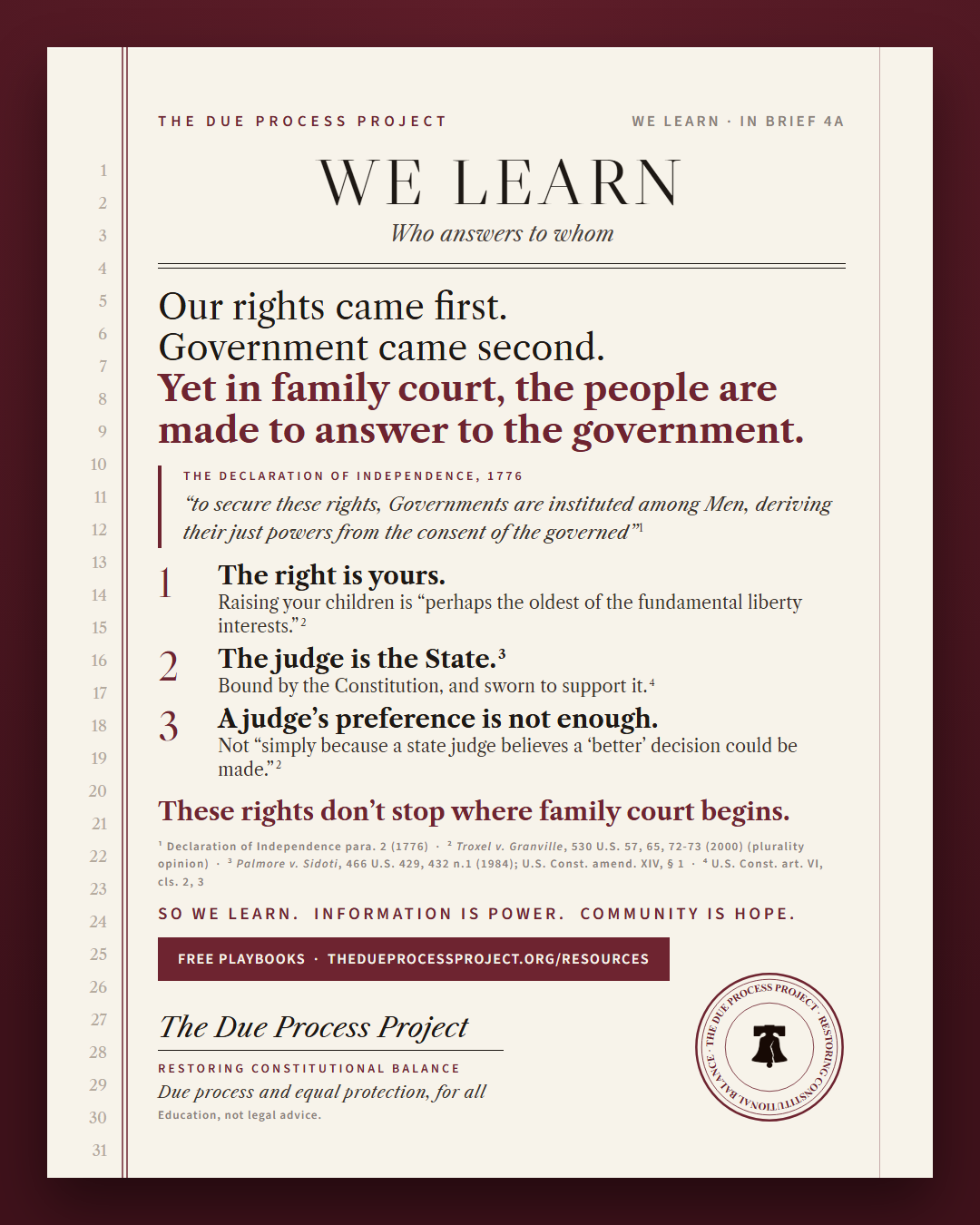
Card from The Due Process Project. We Learn, In Brief 4A: Who answers to whom. Headline: Our rights came first. Government came second. Yet in family court, the people are made to answer to the government. A quote from the Declaration of Independence, 1776: "to secure these rights, Governments are instituted among Men, deriving their just powers from the consent of the governed." Three points. One: The right is yours. Raising your children is "perhaps the oldest of the fundamental liberty interests." Two: The judge is the State. Bound by the Constitution, and sworn to support it. Three: A judge's preference is not enough. Not "simply because a state judge believes a 'better' decision could be made." Closing line: These rights don't stop where family court begins. Free Playbooks at thedueprocessproject.org/resources. Restoring Constitutional Balance. Education, not legal advice.
The card as posted. Tap it to open full size. © 2026 The Due Process Project.

WE LEARN.
In Brief 4A: Who answers to whom.

America was won for our freedom. Our rights came first. Government came second, built to protect those rights, and holding only the power we the people give it.

The Declaration of Independence proclaims that we are "endowed by [our] Creator with certain unalienable Rights." Governments are formed "to secure these rights," and their just powers come "from the consent of the governed."¹

That is the freedom our founders declared, and the freedom generations of Americans have fought and died for, at home and abroad. Freedom from a government that reaches too far.

The freedom to raise your own children is among the oldest of those rights. Our own Supreme Court, in the lead opinion in Troxel v. Granville, called it "perhaps the oldest of the fundamental liberty interests recognized by this Court."²

Family court is not outside the Constitution. When a family court judge acts against your rights, that is the State acting.³ Every judge in every state is bound by the Constitution and swears an oath to support it.⁴ Under the Due Process Clause, a judge cannot override a fit parent "simply because a state judge believes a 'better' decision could be made."²

We argue that across this country, family courts have lost sight of those limits. The oath is all but forgotten. Cases turn instead on local rules, policies, customs and unwritten habits, with little procedural rigor.

The result turns the founding promise upside down. In family court, the people are made to answer to the government. Parents must prove themselves to the very government built to protect them.

The goal is balance: a government that answers to the people again.

These rights don't stop where family court begins.

Information is power. Community is hope.
Share this. Let every family hear it.

Missed Part 4? Start there: https://www.facebook.com/thedueprocessproject/posts/pfbid028bfAptidQk6RpzdyNTrb94PGjSgWQ4jUQ1x2em3ya947SM23F8zptxchfetrHzXHl

¹ The Declaration of Independence para. 2 (U.S. 1776).
² Troxel v. Granville, 530 U.S. 57, 65, 72-73 (2000) (plurality opinion).
³ Palmore v. Sidoti, 466 U.S. 429, 432 n.1 (1984); U.S. Const. amend. XIV, § 1.
⁴ U.S. Const. art. VI, cls. 2, 3.

If you are in immediate danger, call 911. Domestic violence support: 1-800-799-7233.

Restoring Constitutional Balance. Due process and equal protection, for all.
Education, not legal advice.

Check it yourself

Our first comment on the post, as posted:

Check it yourself. Each number in the post matches a source below, from the National Archives and the Supreme Court's own opinions in the official U.S. Reports. The two case links open the official PDF; on most computers it opens at the quoted page, and some browsers download it instead.

¹ The Declaration of Independence para. 2 (U.S. 1776)
https://www.archives.gov/founding-docs/declaration-transcript

² Troxel v. Granville, 530 U.S. 57, 65, 72-73 (2000) (plurality opinion) (PDF)
https://tile.loc.gov/storage-services/service/ll/usrep/usrep530/usrep530057/usrep530057.pdf#page=9

³ Palmore v. Sidoti, 466 U.S. 429, 432 n.1 (1984) (PDF)
https://tile.loc.gov/storage-services/service/ll/usrep/usrep466/usrep466429/usrep466429.pdf#page=4
U.S. Const. amend. XIV, § 1
https://www.archives.gov/founding-docs/amendments-11-27

⁴ U.S. Const. art. VI, cls. 2, 3
https://www.archives.gov/founding-docs/constitution-transcript

The Court's words and the founders' words are in quotation marks. Everything else is ours.

Education, not legal advice.

As posted on our Facebook Page on Friday, November 20, 2026. See the original post.

© 2026 The Due Process Project. You may share this chapter and its card unaltered, with this notice, for non-commercial use, as our Terms of Use allow. The court opinions, statutes and constitutional text it quotes are public law.

Next: Notice to the People of Washington · Contents

State Notices

Notices written for the people of one state, under that state's own laws.

State Notice · Washington · November 12, 2026

Notice to the People of Washington

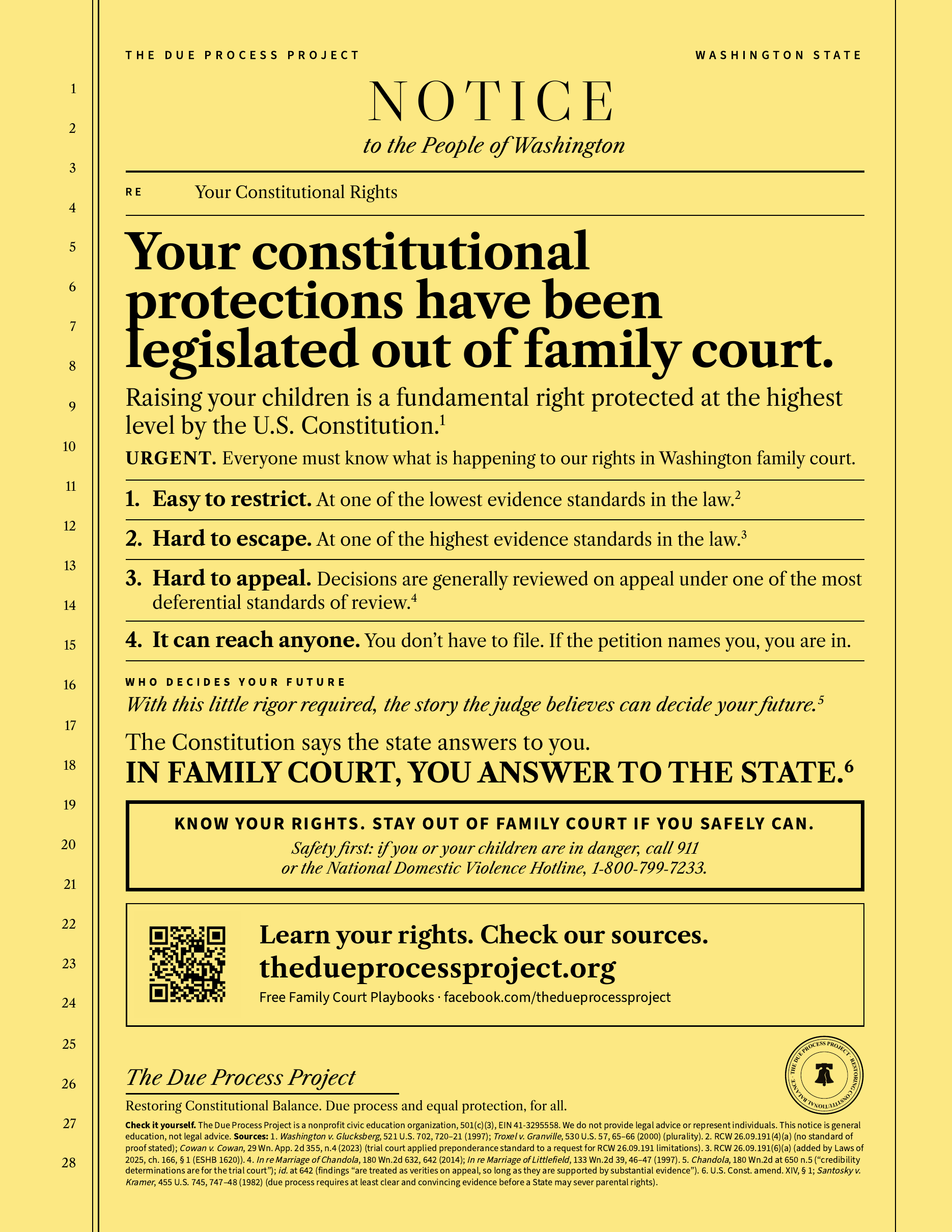
A yellow notice from The Due Process Project titled "NOTICE to the People of Washington," RE: Your Constitutional Rights. Headline: "Your constitutional protections have been legislated out of family court." It says raising your children is a fundamental right protected at the highest level by the U.S. Constitution, then lists four points: easy to restrict, at one of the lowest evidence standards in the law; hard to escape, at one of the highest; hard to appeal, under one of the most deferential standards of review; and it can reach anyone. Under "Who decides your future" it says: "With this little rigor required, the story the judge believes can decide your future." It ends: "The Constitution says the state answers to you. In family court, you answer to the state." Then: "Know your rights. Stay out of family court if you safely can." A safety line says to call 911 or the National Domestic Violence Hotline, 1-800-799-7233, if you or your children are in danger. Footnoted sources and thedueprocessproject.org are at the bottom.
The card as posted. Tap it to open full size. © 2026 The Due Process Project.

NOTICE to the People of Washington.

Raising your children is a fundamental right protected at the highest level by the U.S. Constitution. In Washington family court, a judge can restrict that right on one of the lowest standards of proof in the law. Escaping the restriction takes one of the highest. An appeal can fix legal errors, if you can afford the time and money. But the higher court won't reweigh the facts, and it gives the judge's decisions about your children some of the strongest deference in the law.

Many people don't even start to realize this until something unwarranted happens to them in court. They don't know their rights well enough to assert them, and they assume the system defends those rights for them. It doesn't. The system treats a case between parents as a private matter, as if the State were not an actor at all. Then the State's order lands on them, and they are left confused and turned around, looking to a system that exists on paper but not in reality.

We want every Washington family to know this before that day comes.

This Notice is for Washington. If you live in another state, you are not forgotten. We are already working through every state's laws, side by side, and building connections with people across the country who are doing this work too. More is coming.

Read the Notice carefully. The law behind it is footnoted, and the full sources are in the first comment. Check it yourself.

If it matters to you, share it with one Washington family who should see it.

The Due Process Project is a nonprofit civic education organization, 501(c)(3). This is general education, not legal advice.

Check it yourself

Our first comment on the post, as posted:

Check it yourself. The sources behind the Notice's six footnotes:

Footnote 1 (a fundamental right): Washington v. Glucksberg, 521 U.S. 702, 720-21 (1997); Troxel v. Granville, 530 U.S. 57, 65-66 (2000) (plurality).

Footnote 2 (easy to restrict): RCW 26.09.191(4)(a) (no standard of proof stated); Cowan v. Cowan, 29 Wn. App. 2d 355, n.4 (2023) (trial court applied preponderance standard to a request for RCW 26.09.191 limitations), review denied, 2 Wn.3d 1020 (2024).

Footnote 3 (hard to escape): RCW 26.09.191(6)(a) (added by Laws of 2025, ch. 166, § 1 (ESHB 1620)).

Footnote 4 (hard to appeal): In re Marriage of Chandola, 180 Wn.2d 632, 642 (2014); In re Marriage of Littlefield, 133 Wn.2d 39, 46-47 (1997).

Footnote 5 (who decides your future): Chandola, 180 Wn.2d at 650 n.5 ("credibility determinations are for the trial court"); id. at 642 (findings "are treated as verities on appeal, so long as they are supported by substantial evidence").

Footnote 6 (the state answers to you): U.S. Const. amend. XIV, § 1; Santosky v. Kramer, 455 U.S. 745, 747-48 (1982) (due process requires at least clear and convincing evidence before a State may sever parental rights).

For the caption (the order is the State's): M.L.B. v. S.L.J., 519 U.S. 102, 116 n.8 (1996) (termination case begun by private parties; "the challenged state action remains essentially the same").

Read them yourself:
Glucksberg, p. 720: https://tile.loc.gov/storage-services/service/ll/usrep/usrep521/usrep521702/usrep521702.pdf#page=19
Troxel, p. 65: https://tile.loc.gov/storage-services/service/ll/usrep/usrep530/usrep530057/usrep530057.pdf#page=9
Santosky, p. 747: https://tile.loc.gov/storage-services/service/ll/usrep/usrep455/usrep455745/usrep455745.pdf#page=3
M.L.B., p. 116 (n.8): https://tile.loc.gov/storage-services/service/ll/usrep/usrep519/usrep519102/usrep519102.pdf#page=15
14th Amendment: https://www.archives.gov/founding-docs/amendments-11-27
RCW 26.09.191: https://app.leg.wa.gov/RCW/default.aspx?cite=26.09.191
Cowan, n.4: https://www.courts.wa.gov/opinions/pdf/830821orderandopin.pdf#page=7
Laws of 2025, ch. 166, (6)(a): https://lawfilesext.leg.wa.gov/biennium/2025-26/Pdf/Bills/Session%20Laws/House/1620-S.SL.pdf#page=16
Chandola, p. 642: https://static.case.law/wash-2d/180/html/0632-01.html#p642
Chandola, n.5: https://static.case.law/wash-2d/180/html/0632-01.html#footnote_1_5
Littlefield, p. 46: https://static.case.law/wash-2d/133/html/0039-01.html#p46

General education, not legal advice.

The full Notice, with each of its six footnotes and links to the law, is on its own page: Notice to the People of Washington: check it yourself.

As posted on our Facebook Page on Thursday, November 12, 2026. See the original post.

© 2026 The Due Process Project. You may share this chapter and its card unaltered, with this notice, for non-commercial use, as our Terms of Use allow. The court opinions, statutes and constitutional text it quotes are public law.

More chapters are added as we publish them. · Contents

If you are in immediate danger, call 911. Domestic violence support: 1-800-799-7233.

The Due Process Project is a nonprofit civic education organization. We do not provide legal advice or represent individuals. Everything in this Library is general education, not legal advice.

© 2026 The Due Process Project. All rights reserved, except that you may share any chapter or card unaltered, with this notice, for non-commercial use, as our Terms of Use allow. The court opinions, statutes and constitutional text we quote are public law and belong to everyone.